
An Unsolved Mystery
On this 36th anniversary of the Gardner Museum Heist, I am reposting an essay I wrote two years ago about the museum's memorialization of the stolen art.

Some Thoughts on the Gardner Museum’s Empty Frames
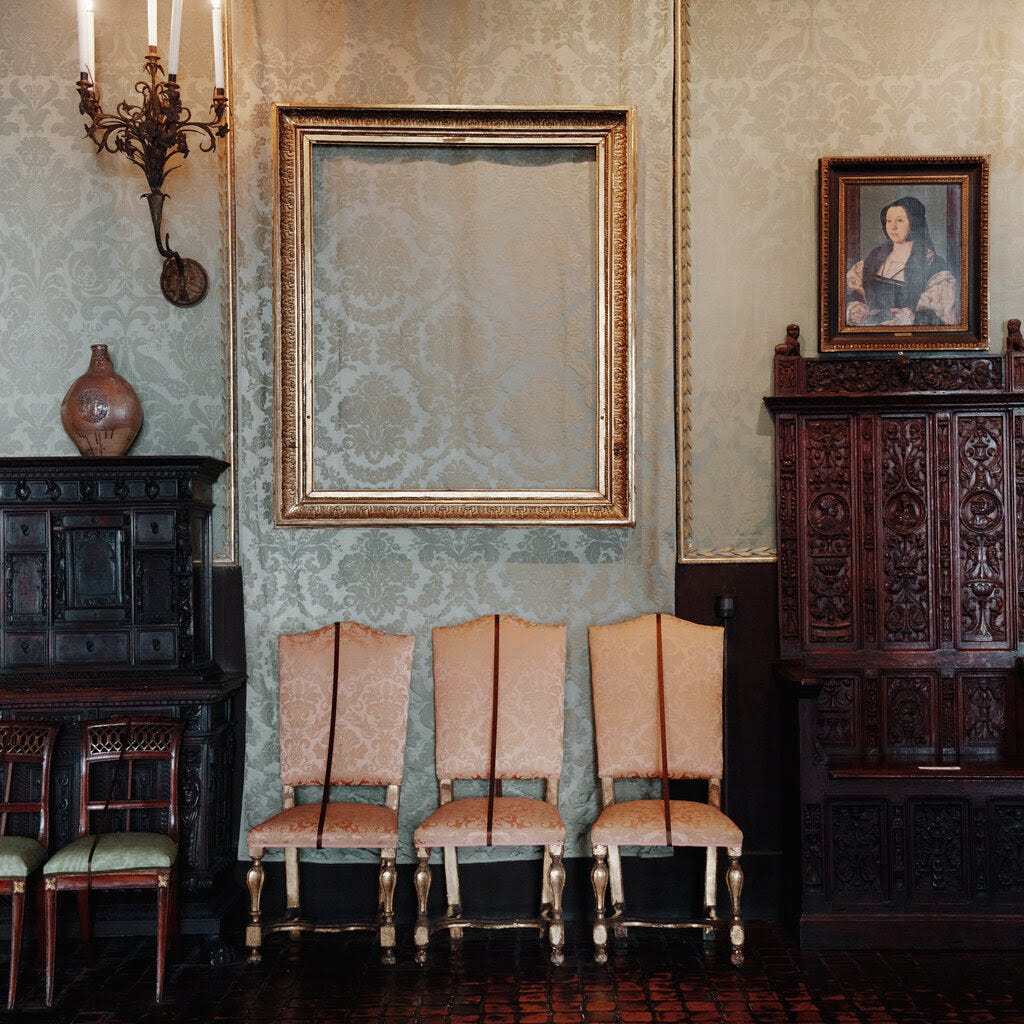
At the Isabella Stewart Gardner Museum, Boston. Tony Luong for The New York Times
34 years ago today, in the early hours of March 18, 1990, thieves gained entry into the Isabella Stewart Gardner Museum in Boston, disguised as Boston police officers investigating a reported disturbance. After more than two hours on the premises, they disappeared with 13 artworks, from priceless Rembrandts and a Vermeer, to the bronze eagle finial from a flagpole. None of the works has been returned, and the trail has gone cold, especially after the deaths of a few people of interest to the investigators. The frames and pedestals remain empty.
Recently, I had the opportunity to visit. More than the art that is left, which includes a priceless array of important work, I wanted to see the empty frames. Have you seen them? The empty frames scattered among different galleries in the Gardner Museum are lit as if they still surrounded their original charges. It’s a very dramatic effect. A visitor is just as likely to stumble across one of these echoes of their stolen treasures as they are to find them by design. And yet, seen by chance or by choice, their very emptiness is jarring. It puts the visitor back on her heals, even when she knew the story of their theft.
Those frames that acted as supporting characters, both drawing attention to their prize and protecting their ward, stand testament to the terrible loss of rarities. None of the art works which were stolen in the dark hours of that March night can be replaced. This is partly why the museum has chosen to leave the discarded frames on the wall.* Some were even repaired to be returned to their original placement. The frames stand in for their unique contents in memoriam as a lover erects a funerary monument to their lost paramour.
But the empty frames are not the only memorial monuments in the museum. There is a lovely collection of sarcophagi that Mrs. Gardner amassed in her mansion. A collection that you must pass by to reach the rooms with the empty frames. The Farnese Sarcophagus is the most famous of the sarcophagi, although there are others scattered around the museum. With its relief of revelers, maenads and satyrs in a Bacchanalian feast, it depicts a life lived to the fullest. Such scenes were inspired by the Etruscan practice of depicting the dead on the lids of their sarcophagi reclined at an eternal feast, as if to depict it they have secured such a fate.


View of the gallery with the Farnese Sarcophagus and a detail. Photos: Isabella Stewart Gardner Museum
Because the lid was lost prior to the discovery of the sarcophagus, scholars don’t know to whom the coffin belonged. They have confidently dated it to early in the 3rd century. The museum suggests it was made in Rome around 225 CE, and its history can be traced from its discovery in Tivoli in the 16th century through the Farnese Family, a couple of Popes and a king, but its particular history between its fabrication and its discovery is lost.
It is important to remember that this glorious carved marble box was, in fact, a funerary monument to an individual. There was, most certainly, a body in there, who was removed at some point. And while Mrs. Gardner didn’t steal it (the sarcophagus was in fact purchased by her husband), it was, at some point, “discovered.” Let’s consider that discovery.
By the third century CE, Romans were burying their dead in catacombs. The more affluent were buried in sarcophagi. Marble was one of the most expensive materials used for such purposes. In all likelihood, this particularly spectacular example of relief carving was “discovered” in a catacomb. The lid, which may have included an identifying inscription or even a portrait likeness, was removed. And the bones that would have been left, were discarded. At great effort, the heavy box itself would have been removed from the catacomb. The sarcophagus’s condition, empty with no lid, serves a similar supporting role that the empty frames do. What is lost is irreplaceable, at least to the person who ordered this monument.
Please understand that I’m not trying to suggest that the sarcophagus needs to be repatriated, as many recently looted artifacts should be. So many are obtained by raiding the resting places of the long dead. And while those dead may not be identifiable, that does not mean that there are no ancestors who are violated by the removal of burial objects.
In the case of the Farnese Sarcophagus, the extensive documented provenance of the ancient work in individual hands after its discovery, and its sale to the Gardners in 1897 renders it legitimately the property of the museum, at least as far as the law is concerned. I don’t question that.
Instead, I am merely trying to articulate what may be a violence or trauma at the heart of collecting art and antiquities. The owning of such unique things is perhaps not possible without the threat or actuality of theft. And the objects themselves are almost always a memorial of that very possibility, the punctum that Roland Barthes describes at the heart of photography, that possibility of a photograph, of his dead mother in Barthes’s case, to cause an intense and subjective effect on the viewer, one wrapped in memory. Barthes rightly pointed out that photography, in its ability to act as a ‘living image of a dead thing’ had its roots in ancient funerary objects. However, he maintains that photography is singular in its ability to elicit this intense and subjective effect on the viewer. I don’t agree. In the case of the empty frames at the Gardner, the viewer feels the prick of a similar punctum, the power of the loss, displayed as emptiness surrounded by a frame, like a mourning lover draped over the funerary monument.
This is a great essay, Eileen! A visit to the Gardner Museum is on my bucket list. I